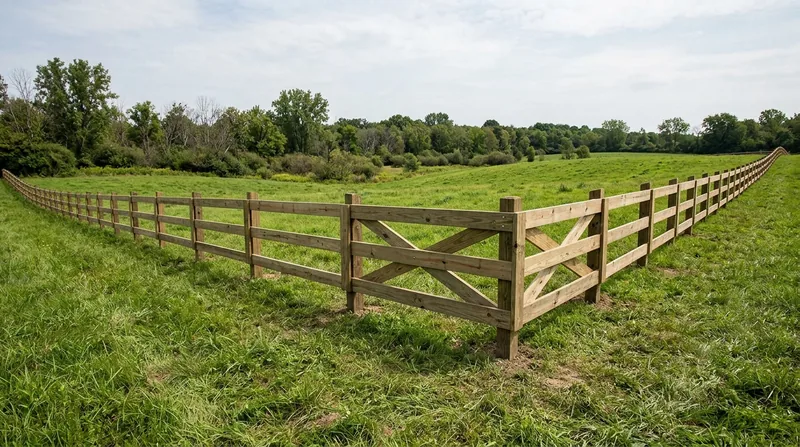




Farm fence installation in Detroit serves the horse and livestock owners, orchardists, and acreage holders across northern Macomb, western Oakland, and Monroe counties. Unlike suburban privacy fencing, ranch and farm fencing must withstand livestock pressure, weather exposure, and the weight of equipment moving through gates day in and day out. Detroit Fence Pros has built field fencing since 2010 for properties where the fence line marks a working boundary, not just a property marker. We work with split rail, no-climb horse fence, field wire, and pipe fencing on acreage where suburban contractors rarely venture. This page covers what farm and ranch fencing costs, how we build it, and what to expect when you call.
Why Farm & Ranch Fencing Matters in Detroit's Acreage Communities
Acreage beyond the suburbs demands fencing that works harder than a privacy fence. Horses test a fence line constantly. Cattle and sheep push against it. Snow load, wind, and freeze cycles stress posts and rails. A fence built for suburban setback and aesthetics will fail on a working farm. Detroit-area properties in the horse country of northern Macomb and western Oakland counties need fencing engineered for containment, durability, and the practical realities of livestock and equipment access.
- Split rail and no-climb horse fencing contain animals safely without sharp edges or gaps that trap hooves or legs.
- Pipe fencing handles the weight of gates that swing open for tractors, trailers, and daily farm traffic.
- Field wire and barbed wire fencing secure larger acreage where labor and material costs favor practical, durable design over ornamental finish.
- Post spacing and rail height are set by the animal type and local code, not by suburban convention.
- We set posts in concrete to frost depth and brace rails against the lateral pressure that livestock and equipment create.
The right fence holds for years. A fence built wrong fails within seasons, and replacement costs far more than getting it right the first time.
Key info: Horse fencing in the Detroit area must meet the American Fence Association guidelines for no-climb and split rail design. We build to those standards and help you verify any HOA or deed restrictions that govern height, material, or color on your acreage. Before any post goes in the ground, call 811 for a utility locate (Michigan law requires it), and verify your property line with your existing survey.
For more detail on fencing methods and materials across our service area, see our main fencing services.
Reference: Michigan.gov covers state regulations; your local city or county building department sets setback and height rules specific to your property.
How We Build Farm & Ranch Fencing: The Detroit Fence Pros Process
Farm fencing is measured in linear feet and built to withstand constant pressure. We start with a site walk to understand the terrain, the animal type, the gate locations, and the property boundaries you've identified. We then specify post depth, rail size, spacing, and bracing. Most acreage fencing in the Detroit area uses pressure-treated wood or galvanized pipe because both resist ground-line moisture and weather exposure far better than untreated material. We set posts in concrete, space them to code and animal type, and brace rails with anti-sag hardware where livestock or wind load demands it.
- We verify your property line and confirm the fence location with your survey and local setback rules before we stake the line.
- We call 811 for utility locates to protect buried lines before any post hole is dug.
- We set posts in concrete at frost depth to prevent heave and movement during freeze cycles.
- We install rails and wire with proper tension and bracing so the fence holds under animal pressure and weather stress.
- We hang gates with self-closing, self-latching hardware or cantilever track systems that work reliably in daily use.
A well-built farm fence outlasts suburban fencing because it's engineered for the load, not just the look.
Local example: A 10-acre horse property in the Troy or Warren area typically needs split rail fencing around paddocks (no-climb design to prevent leg entrapment) and a stronger pipe or field-wire perimeter. We set posts 8 feet apart for split rail, 10 feet for pipe, and install anti-sag bracing on any section longer than 100 feet. A driveway gate gets a cantilever hinge system or a linear track operator so it opens smoothly under its own weight and doesn't sag into the post over time.
For details on gate installation and repair, including automatic driveway systems, see our dedicated page.
Farm & Ranch Fencing Methods and Materials
| Approach | Description | Best for |
|---|---|---|
| Split Rail | Horizontal rails mortised or bolted to vertical posts, typically 3 or 4 rails high, pressure-treated or cedar. | Horses, paddocks, ornamental acreage boundaries. Classic look, moderate cost, requires post maintenance. |
| No-Climb Horse Fence | Rigid wire mesh welded to horizontal rails, typically 4x4 inch or 2x4 inch openings, galvanized or powder-coated. | Horse containment and safety. Prevents hooves and legs from catching. Durable, low maintenance, higher initial cost. |
| Pipe Fencing | Steel or aluminum pipe posts and rails, galvanized or powder-coated, bolted or welded together. | Heavy livestock, equipment gates, perimeter containment. Extreme durability, withstands impact and pressure, highest cost. |
| Field Wire & Barbed Wire | Wire mesh or strands stapled or clipped to wooden posts, typically with wooden top rail for visibility. | Large acreage, cattle, sheep, perimeter security. Low cost per foot, practical, requires regular post and tension inspection. |
Farm & Ranch Fencing Cost in Detroit: What to Expect
Farm and ranch fencing costs depend on material, post spacing, terrain, and gate requirements. A basic split rail fence starts at around $12 to $18 per linear foot installed, including posts set in concrete and rail bracing. No-climb horse fencing runs $15 to $25 per linear foot because of the welded mesh and hardware. Pipe fencing, the most durable option, ranges from $20 to $35 per linear foot depending on pipe diameter and whether gates are included. Field wire fencing with a wooden top rail may run $8 to $14 per linear foot for basic perimeter work on large acreage.
Costs rise when terrain is rough, posts must be set deeper than standard frost depth, or gates are complex. A driveway gate with a cantilever hinge system or automatic opener adds $1,500 to $4,000 depending on width and operator type. Always get two or three written estimates before you commit. We offer free estimates with no obligation, and we respond within 24 hours at (313) 513-0521.
See our full pricing page for detailed breakdowns by material and scope.
Farm & Ranch Fencing Near Me: What Detroit Homeowners Should Know Before You Hire
Hiring a fencing contractor for acreage work requires more due diligence than suburban fence jobs because the stakes are higher. Your fence contains valuable animals and equipment, and it may mark a legal boundary. Start by confirming that any contractor you interview is fully insured and can provide a certificate of insurance. Ask for references from recent farm or ranch projects in your area, and call at least two of them. Verify that the contractor understands local setback and height rules, and confirm whether your HOA or deed restrictions govern fencing material or color. If you have a survey, bring it to the estimate appointment so the contractor can mark the fence line accurately.
Before digging, the contractor must call 811 for utility locates (Michigan law requires it). If your property has protected trees or significant vegetation near the fence line, ask whether the contractor has experience preserving them. Finally, get everything in writing: the material spec, post spacing, gate design, timeline, and total price. A handshake is not a contract, and a vague estimate leads to disputes and cost overruns.
Ready to move forward? Contact Detroit Fence Pros for a free, no-obligation estimate. We serve Detroit, Warren, Troy, Sterling Heights, Dearborn, Livonia, and surrounding areas in Greater Detroit. Call (313) 513-0521 or request an estimate online.
Farm & Ranch Fencing in Detroit: Pricing Guide
| Service | Price | Details |
|---|---|---|
| Split Rail Fencing | Starting at $12/ft | Posts set in concrete, 3 to 4 rails, pressure-treated or cedar, spacing per animal type |
| No-Climb Horse Fencing | Starting at $15/ft | Welded wire mesh, galvanized or powder-coated, 2x4 or 4x4 inch openings, anti-sag bracing |
| Pipe Fencing | Starting at $20/ft | Steel or aluminum pipe, galvanized or powder-coated, bolted or welded, extreme durability for livestock and equipment |
| Field Wire & Barbed Wire | Starting at $8/ft | Wire stapled to wooden posts, typically with wooden top rail, practical for large acreage and perimeter containment |
| Driveway Gate Installation | Starting at $1,500 | Cantilever hinge system or linear track; automatic opener and operator additional; sized and rated for your equipment |
| Free Estimate | No charge | Response within 24 hours; site walk, material spec, and written price; no obligation to book |
Indicative pricing, the exact cost depends on square footage, finish, and site access. Free personalized estimate within 24h at (313) 513-0521.


